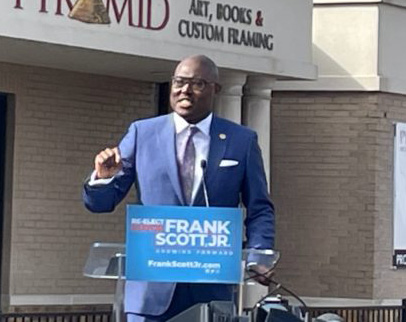

Mayor Frank Scott Jr. launches reelection bid, says jobs not finished yet
March 14-20, 2022
By Wesley Brown
With less than nine months left before the city’s next mayor election, Mayor Frank Scott Jr. (left)continues to maintain the upbeat campaign spirit that swept him into office in January 2019 after a runoff election against Little Rock businessman Baker Kurris in late 2018.
Two weeks after launching his reelection bid in the Dunbar Historic District on Feb. 1, Scott is asking the citizens of Little Rock to reelect him to a second term in November as the city’s first Black mayor. To date, Little Rock businessman and auto dealer Steve Landers, Loretta Hendrix and Greg Henderson have also announced their intentions to jump in the mayor’s race in the fall.
Hendrix is the daughter of the late Little Rock Ward 1 City Director Erma Hendrix, who died in September. Henderson is founder of Rock City Eats and the marketing firm Rock City Interactive. He previously ran for city director for the city-wide At Large Position 10, losing to longtime City Director Joan Adcock.
The filing deadline for this election is Aug. 10, 2022. The general election for mayor will be held on Nov. 8, and a runoff election is scheduled for Dec. 6, if necessary. In a sit-down interview at Nexus Coffee shop in Little Rock’s River Market district on Feb. 9, Scott told The Daily Record that his first three years have been historic on many levels despite “unprecedented and unseen” challenges.
“As we reflect on the past three years, it is always good to understand the context of what we’ve been able to accomplish in a pandemic,” Scott said. “When I think of that, my mind often goes back to Dec. 14, 2018, but taking that oath of office beside my mother and my very young cousins and Judge Alice Gray who gave me my oath, I would have never thought that in January 2019 we would experience a 100-year flood, a historic snowstorm, a global pandemic and the murder of George Floyd that quite frankly brought back memories of the 1960s.
“To lead (Little Rock) through those crises, both environmental, societal and as well as the (pandemic), if you would have told me – I would’ve never believed it,” said Scott.
As part of his Rebuild the Rock progressive agenda, Scott has sought to implement a forward-thinking, post-pandemic vision to make Little Rock a top southern destination and renaissance city. A big part of that agenda, which included a one percent sales tax hike to generate $531 million over the next decade, has mostly stalled in the mayor’s third year in office.
Despite those challenges, Scott said together with his great staff, his administration was able to accomplish several of its key goals that were part of the first campaign that swept him into office in late 2018.
“To persist and to prevail with our overarching purpose … unite, grow and transform our city and truly make Little Rock a catalyst for the new South,” he said. “Despite all that, we have announced more than 7,000 new jobs across all sectors, which is five times more than the previous five (years). So, there has been historic jobs growth in the state’s capital city and so we are grateful for our economic development partners.”
Often calling himself the city’s “chief growth officer,” Scott said the “proof was in the pudding” in bringing corporate brand names to Little Rock, including Amazon, Trex, Costco, Trader Joe’s, and Alleviant Health.
“When you have those types of companies, it’s because they see something in Little Rock,” said Scott.
In addition to his job growth plan, Scott also pointed to implementing the city’s first diversity, equity and inclusion office and keeping his campaign promise to return the Little Rock School District back to local control. To accomplish that latter goal, Scott appointed former State Board of Education Director Jay Barth as the city’s first Chief Education Officer in early 2020.
In November 2020, an election was held for the first duly elected school board since 2015. In December 2020, a runoff election was held for two seats on board to complete the nine-person oversight panel. The seven other seats on the board were decided in the general election. In July 2021, the State Board of Education voted unanimously to return control of the Little Rock School District back to the community and remove the state’s second-largest school district from under the foot of the state.
“It is good to understand that our local school board was under state control, and I pledged that the city of Little Rock would put its money where its mouth was by getting involved and truly having strategic partnership with the school district that helped pave the way to bring the school district back to local control,” said Scott.
Scott said not only is Little Rock now operating with oversight from a locally elected school board, but the city’s “community school model” has set an example for other Arkansas communities to follow to take back control of their local school districts. “It is a model for other school districts where they want a true strategic partnership between schools and municipalities,” he said.
In addition, following his techno-flashy State-of-the-City “Rebuild the Rock” address in late March 2021, Scott promised the new hire to establish the city’s first DEI Officer as part of his new Equity at Work initiative. A month later, Scott announced the hiring of Dionne Jackson as the city’s new chief equity officer. At the time, Scott said equity and inclusion brings diverse voices and viewpoints to the table in all city affairs.
“By hiring our first chief equity officer, it not only focuses on equity from an internal standpoint at City Hall, but it also ensures that we are truly reflective of our city’s growing and diverse majority population that truly represents the global economy and represent the global population across this world,” said Scott, a Baptist minister. “What we are doing truly focuses on diversity, equity and inclusion and making sure that it’s not a buzzword, but it is truly intentional and cultural and the fabric and character of our city.”
Mayoral master plan
In other areas, Scott said that his administration has also continued to revitalize the city’s park and recreation department, move forward with upgrading infrastructure across the city, “right-sizing” city government with $5 million in budget cuts in 2020, approving and buying body cameras for the city’s policy department, and revamping the city’s small business outreach program.
Scott’s citywide master plan also includes the Asher Avenue Corridor revitalization project and what he calls the “South of I-630-East of I-30” economic development incentive plan to spur new development to all areas of the city.
“We have been able to do a lot,” Scott said, outlining an extensive list of his accomplishments.
However, Scott admitted that after some major setbacks in the stretch run of his four-year term as the city’s first Black chief executive, there is still a lot more that his administration plans to accomplish if reelected to a second term.
Admittedly, Scott has run into some stiff opposition from the 10-person City Board of Directors as he has sought to make strides on a campaign promise to implement a “strong mayor” form of government where all city departments report directly to him, including longtime City Manager Bruce Moore. Concerning a failed attempt by ally and City Director Antwan Phillips to change the city’s at-large form of government, Scott said that is something Little Rock residents will have to decide in the future through the ballot or by petitioning the City Board.
“Our current form of government operates well because of strong leadership and the mayor being the CEO, something I think people have never seen before,” Scott said. “But I do think there has been a response that people want us to move from the step we took in Jan. 2019 to another level. But that is for the citizens to decide, and we always want to be on the right side of the citizens.”
Also, as part of his Rebuild the Rock progressive agenda, Scott also sought to implement a one percent sales tax hike to generate $531 million over the next decade. The largest-ever capital campaign, however, was rebuffed by Little Rock voters in a special election last September.
“Clearly, I was disappointed that the Rebuild the Rock sales tax initiative didn’t pass, which I firmly believe was a bold initiative to build our city’s future. In life, I don’t subscribe to losses, I subscribe to lessons learned,” explained Scott. “As we’ve regrouped, it spurned even more motivation and desire to focus on bold initiatives but continuing to understand how to become a little bit more targeted in those initiatives and continue to focus on the quality of life and place in the City of Little Rock and to truly take us into the next future.”
To assist him in that effort, Scott announced in late January that longtime senior advisor Kendra Pruitt will now serve as chief of staff, replacing former legislator and Arkansas House Minority leader Charles Blake. Stephanie Jackson, the mayor’s former chief spokesperson, also resigned from her part-time role on Jan. 3.
Like Blake, Jackson served on the campaign staff for Scott’s historic race to become the city’s first duly elected Black mayor in November 2018. They both are now realigned with Scott’s re-election bid, he said.
“We firmly believe that we are positioned to win. We take nothing for granted. We are going to ask everyone for their vote,” said Scott.
Looking toward the future, if given a second term, Scott said his administration will focus on continuing to upgrade the city’s parks and youth sports program, including making the Fair Park and War Memorial area “The Central Park of Little Rock.” That agenda also includes continuing to focus on rebuilding the city’s infrastructure and inner city, developing an indoor-outdoor sports complex, and focusing on youth programming.
“We have to continue to focus on infrastructure – sidewalks, streets and drainage in very targeted areas of our city, but also we move forward where we have to also focus on what we are doing for youth and young adults, and what we are going to do to retain our youth and young adults so we won’t experience a brain drain and continue to rebuild for the future. So, we are retooling as we regroup.”
Scott said although he doesn’t plan to reintroduce his Rebuild the Rock campaign, he will soon announce another branding campaign that focuses on rebuilding downtown and other urban areas of the city that have been neglected by past administrations – including south of I-630 and east of I-30.
“What do we do to propel the positive economic growth that west Little Rock and Midtown is seeing? How do we create more culture and understanding of the different flavors of our city and invest in them from that standpoint?” Scott asked. “Cities that make an investment in quality of life and place as we enter into a post-pandemic world will be the ones that recover first.”
Turning to the city’s crime spree that included a dozen homicides in the first two months of 2022, Scott has spent much of the new year discussing steps his administration has taken to curb violent crime, including declaring violence as a public health emergency on Feb. 1.
Two weeks later on Feb. 15, Scott offered community service contracts to 11 different agencies that had submitted proposals to help the City’s efforts to curb violent crime. The contracts, were funded out of an allocation of more than $1.5 million in federal American Rescue Plan Act aid set aside by the City Board in August for the purpose of reducing community violence.
Earlier this month, Scott joined Little Rock Police Department officials and the city’s Office of Neighborhood Safety at his weekly press briefing to highlight the fact that one-third of the city’s homicide cases in 2022 were related to domestic violence. Scott, in his Daily Record one-on-one, admitted that he had to make difficult and tough decisions that didn’t please everyone but put the city on the right track.
“What we are hearing from everyday people is they want an economically viable city; they want a city with more entertainment and cultural amenities. They want a city that’s focused on the basic structures of government so they cannot only survive but thrive in the city, and they believe that’s what we’re doing,” explained Scott. “Clearly there is always work to do and that’s why we remain committed and that’s why we’re running for reelection.”