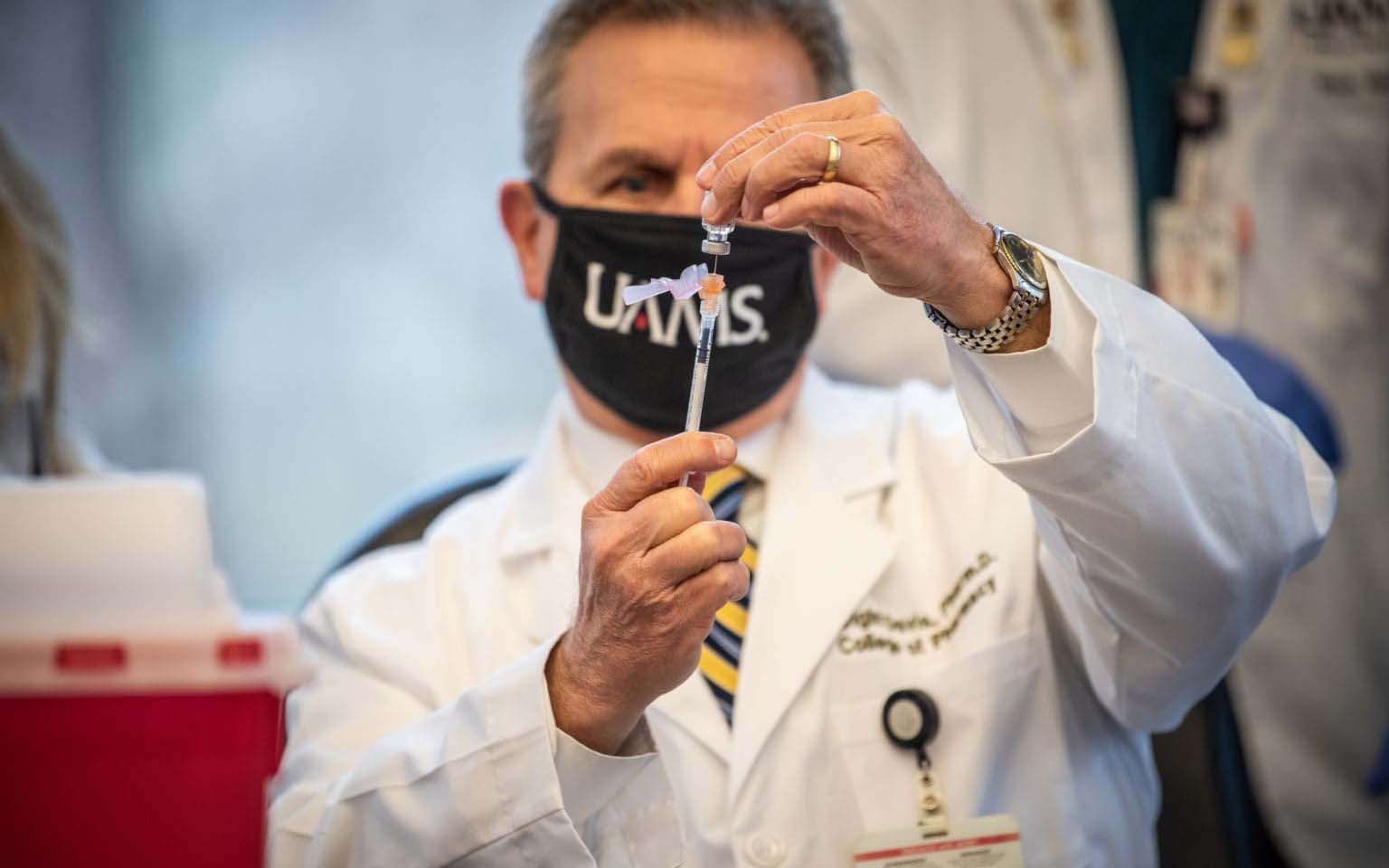

UAMS offers COVID-19 booster shots for patients with weak immune systems
August 23-29, 2021
By The Daily Record Staff
The University of Arkansas for Medical Sciences on Monday began offering COVID-19 booster shots after the Biden administration reversed its policy on whether vaccinated Americans should take a third dose of the government-approved vaccines.
The UAMS booster shot policy came on the same day that Pfizer Inc. and BioNTech SE they had have submitted Phase 1 data to the U.S. Food and Drug Administration (FDA) to support the evaluation of a third, or booster, dose of the companies’ COVID-19 vaccine (BNT162b2) for all adults 16 and older. These data also will be submitted to the European Medicines Agency (EMA) and other regulatory authorities in the coming weeks.
“Vaccination is our most effective means of preventing COVID-19 infection – especially severe disease and hospitalization – and its profound impact on protecting lives is indisputable. Still, with the continuing threat of the Delta variant and possible emergence of other variants in the future, we must remain vigilant against this highly contagious virus,” said Pfizer Chairman and CEO Albert Bourla. “The data we’ve seen to date suggest a third dose of our vaccine elicits antibody levels that significantly exceed those seen after the two-dose primary schedule. We are pleased to submit these data to the FDA as we continue working together to address the evolving challenges of this pandemic.”
Earlier on Aug. 13, the FDA amended its emergency use authorizations (EUAs) for both the Pfizer-BioNTech and Moderna vaccines to allow for the use of an additional dose in certain immunocompromised individuals. More specifically, the vaccine is now available to solid organ transplant recipients or those who are diagnosed with conditions that are considered to have an equivalent level of immunocompromise.
“The country has entered yet another wave of the COVID-19 pandemic, and the FDA is especially cognizant that immunocompromised people are particularly at risk for severe disease. After a thorough review of the available data, the FDA determined that this small, vulnerable group may benefit from a third dose of the Pfizer-BioNTech or Moderna Vaccines,” said Acting FDA Commissioner Dr. Janet Woodcock. “(This) action allows doctors to boost immunity in certain immunocompromised individuals who need extra protection from COVID-19. As we’ve previously stated, other individuals who are fully vaccinated are adequately protected and do not need an additional dose of COVID-19 vaccine at this time. The FDA is actively engaged in a science-based, rigorous process with our federal partners to consider whether an additional dose may be needed in the future.”
On the following day, the U.S. Centers for Disease Control (CDC) and Prevention’s Advisory Committee on Immunization met and endorsed the FDA’s decision. CDC Director Dr. Rochelle Walensky noted that emerging data suggest some people with moderately to severely compromised immune systems do not always build the same level of immunity compared to people who are not immunocompromised.
In addition, Walensky said small studies show fully vaccinated immunocompromised people have accounted for a sizable proportion of hospitalized breakthrough COVID-19 cases, or between 40-44%. Immunocompromised people who are infected with SARS CoV-2 are also more likely to transmit the virus icon to household contacts, she said.
“At a time when the Delta variant is surging, an additional vaccine dose for some people with weakened immune systems could help prevent serious and possibly life-threatening COVID-19 cases within this population,” said the CDC director.
The about-face by the CDC, FDA and NIH comes less than a month after all three federal sub-agencies within the U.S. Department of Health and Human Services issued a joint statement on July 13 after Pfizer first announced that it would seek federal approval to administer a third dose of its vaccine. At the time, the agencies stated that Americans who have been fully vaccinated did not need a booster shot at this time.
“FDA, CDC, and NIH are engaged in a science-based, rigorous process to consider whether or when a booster might be necessary. This process takes into account laboratory data, clinical trial data, and cohort data – which can include data from specific pharmaceutical companies, but does not rely on those data exclusively,” said the joint statement. “We continue to review any new data as it becomes available and will keep the public informed. We are prepared for booster doses if and when the science demonstrates that they are needed.”
To date, CDC and FDA have not provided any guidance on vaccinations for health Americans, especially since the Delta variant spreads rapidly through the nation’s unvaccinated population. According to the CDC, 49% of the 330 million plus U.S. residents are unvaccinated.
In late November 2020, Pfizer Inc. and BioNTech SE first declared that their mRNA-based vaccine candidate against COVID-19, called BNT162b2, had demonstrated evidence of efficacy against COVID-19 in participants without prior evidence of SARS-CoV-2 infection.
The Pfizer vaccine, which originally required two injections 21 days apart, later received FDA fast-track approval on Dec. 12 and the first shipment of the drug arrived in Arkansas about 10 days before Christmas. In earlier trials, Pfizer said its COVID-19 vaccine demonstrated 95% efficacy against infection with minimal side effects.
According to the FDA and CDC, people who are immunocompromised in a manner like those who have undergone solid organ transplantation have a reduced ability to fight infections and other diseases, and they are especially vulnerable to infections, including COVID-19. The FDA said it evaluated information on the use of a third dose of the Pfizer-BioNTech or Moderna vaccines in these individuals and determined that the administration of third vaccine doses may increase protection in this population.
“These patients should be counseled to maintain physical precautions to help prevent COVID-19. In addition, close contacts of immunocompromised persons should get vaccinated, as appropriate for their health status, to provide increased protection to their loved ones,” said the FDA.
It is now recommended that immunocompromised individuals discuss monoclonal antibody treatment options with their health care provider should they contract or be exposed to COVID-19. The FDA has authorized monoclonal antibody treatments for emergency use during this public health emergency for adults and pediatric patients with positive results of direct SARS-CoV-2 viral testing, and who are at elevated risk for progressing to severe COVID-19 and/or hospitalization.
Today, the Pfizer-BioNTech vaccine is authorized for emergency use in individuals ages 12 and older, and the Moderna vaccine is authorized for emergency use in individuals ages 18 and older. Both vaccines are administered as a series of two shots with the Pfizer vaccine administered three weeks apart and the Moderna drug one month apart.
The FDA authorizations for these vaccines have been amended to allow for an additional, or third, dose to be administered at least 28 days following the two-dose regimen of the same vaccine to individuals who have undergone solid organ transplantation, or who are diagnosed with conditions that are considered to have an equivalent level of immunocompromise.
Pfizer and BioNTech SE announced that the U.S. government has purchased an additional 200 million doses of its vaccine. These doses are expected to be delivered from October 2021 through April 2022. This brings the total number of doses to be supplied by the companies to the U.S. government under its existing supply agreement to 500 million.
According to UAMS officials, patients eligible for a COVID booster include the following:
• Those in active treatment for solid tumor and hematologic malignancies.
• Transplant patients who are taking immunosuppressive therapy.
• Those who have received CAR-T cell therapy or a stem cell transplant (within two years of transplantation or still taking immunosuppressive therapy).
• Those with advanced or untreated HIV infection.
• Those undergoing active treatment with high-dose corticosteroids and other pharmaceuticals that are immunosuppressive or immunomodulatory.
Existing UAMS patients should contact their physician to see if they are eligible for a booster and to schedule an appointment.